
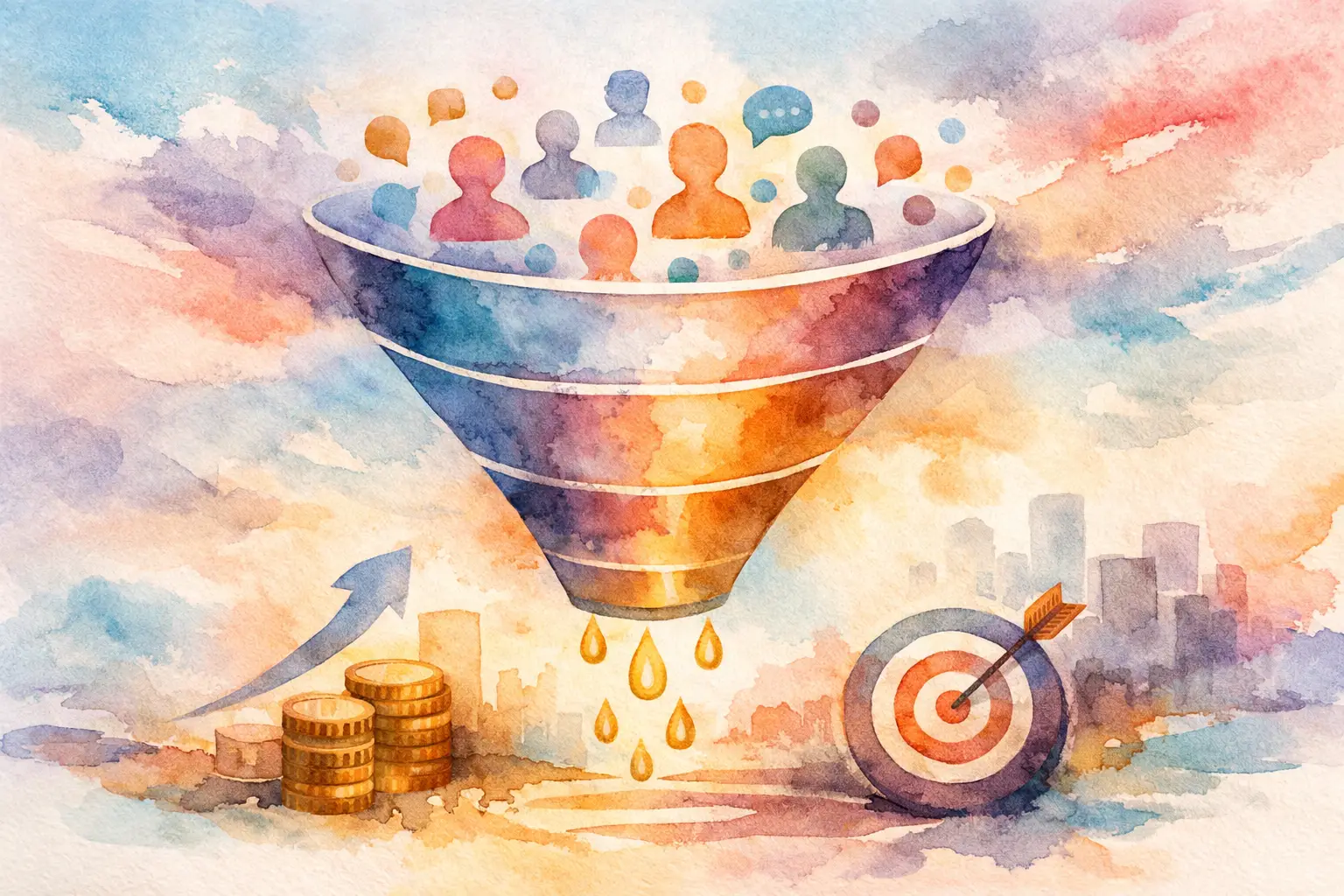
A lot of small and mid-sized businesses do not have a lead problem. They have a funnel problem. Traffic comes in, calls happen, forms get submitted, and then momentum breaks somewhere between first interest and signed customer. A strong lead generation funnel guide starts there – with the gaps that quietly cost revenue.
If you are relying on a website, paid ads, SEO, social media, referrals, or outbound sales, you already have pieces of a funnel. The question is whether those pieces are connected well enough to move prospects forward. When they are not, the result is familiar: missed follow-up, low close rates, inconsistent lead quality, and marketing that looks busy but underperforms.
What a lead generation funnel actually does
A lead generation funnel is the system that turns attention into action and action into revenue. At the top, it attracts the right audience. In the middle, it qualifies interest and builds trust. At the bottom, it creates a clear path to contact, consultation, quote, or purchase.
That sounds simple, but most funnel issues come from friction between stages. A campaign may generate clicks, yet the landing page does not match the ad. A form may capture leads, yet nobody responds fast enough. A sales team may work hard, yet there is no automated nurturing for prospects who are not ready today.
The point of the funnel is not just to collect names. It is to create a repeatable process that gives prospects the right information at the right time while giving your team visibility into what is working.
The five stages in this lead generation funnel guide
For most service businesses, contractors, professional firms, retailers, and multi-location brands, the funnel works best when it is built around five practical stages: attract, capture, qualify, nurture, and convert.
1. Attract the right audience
Lead generation starts before someone fills out a form. Search visibility, paid media, social ads, local SEO, email outreach, and reputation all influence who enters the funnel in the first place.
This is where many businesses overspend. They buy traffic before they are clear on audience intent. If you are targeting broad terms or vague offers, you may get volume without quality. Better targeting usually means fewer junk leads and better close rates.
For a local business, attraction often comes from high-intent channels such as Google Business visibility, service pages, location pages, paid search, and review strength. For a company with longer sales cycles, educational content and remarketing can do more of the heavy lifting.
2. Capture interest clearly
Once someone lands on your site or campaign page, the next step is simple: give them an easy reason to respond.
That might be a quote request, demo booking, free consultation, phone call, pricing inquiry, or downloadable resource. The best capture points are specific and low-friction. If your call to action is generic, or your form asks for too much too early, you will lose people who were ready to engage.
This is also where mobile performance matters. If your page loads slowly, your phone number is hard to tap, or your form is clunky on a smartphone, you are leaking leads before your sales process even begins.
3. Qualify without creating friction
Not every lead deserves the same response. Some are ready to buy. Some are comparing options. Some are not a fit at all.
Qualification helps your team prioritize without making prospects jump through hoops. A few smart questions on a form, a structured intake process, or CRM tagging can tell you whether someone needs immediate sales attention, an automated follow-up sequence, or a different offer.
The trade-off here is real. Too little qualification wastes team time. Too much qualification hurts conversion rates. The right balance depends on your service value, sales cycle, and lead volume. A home services company may need speed first and details second. A B2B company selling higher-ticket solutions may need stronger filtering upfront.
4. Nurture the leads that are not ready yet
This is one of the most overlooked parts of any lead generation funnel guide. Many businesses assume a lead is either hot or lost. In reality, a large percentage of leads need more time, more proof, or better timing.
Nurturing keeps your business in front of those prospects through email sequences, retargeting, follow-up calls, SMS reminders, helpful content, and timely check-ins. The goal is not to flood people with messages. It is to stay relevant until intent increases.
This is where marketing automation becomes valuable. It gives businesses a way to respond consistently without depending on manual follow-up for every inquiry. Done well, automation improves speed, reduces dropped leads, and helps sales teams focus on active opportunities instead of chasing every cold contact the same way.
5. Convert with less friction
At the bottom of the funnel, conversion should feel obvious. The prospect knows what you offer, why it matters, and what to do next. If they still stall, the barrier is often operational rather than promotional.
Poor handoff between marketing and sales, delayed callbacks, unclear pricing, weak proposals, and limited communication options can all drag down conversion. A strong funnel includes the business systems behind the marketing: call routing, CRM workflows, appointment scheduling, proposal delivery, and fast response processes.
That is one reason integrated execution matters. When your website, campaigns, forms, CRM, and communications tools work together, conversion becomes more predictable.
Where most funnels break
Most underperforming funnels fail in one of three places.
The first is message mismatch. Your ad promises one thing, your landing page says another, and your sales conversation heads in a third direction. Prospects lose confidence quickly when the experience feels disconnected.
The second is slow follow-up. For many businesses, the first company to respond has a major advantage. If a lead sits untouched for hours or days, the funnel has already failed, even if your ad campaign was excellent.
The third is lack of visibility. If you cannot track where leads came from, how they moved through the funnel, and where they dropped off, you cannot improve performance with confidence. You are left making budget decisions based on assumptions.
How to build a funnel that fits your business
The right funnel is not identical for every company. A local roofer, a med spa, an e-commerce brand, and a multi-location professional services firm all need different conversion paths.
Start by identifying your highest-value customer actions. For one business, that may be inbound calls. For another, it may be booked consultations or online purchases. Build the funnel backward from that action.
Then align the offer with buyer intent. High-intent prospects may be ready for a quote or estimate. Lower-intent prospects may respond better to educational content, a comparison guide, or a short consultation. If you ask for too much commitment too soon, conversion drops. If you ask for too little, lead quality suffers.
Next, make sure your technology stack supports the process. Your website should load quickly and convert well on mobile. Your forms should route data correctly. Your CRM should track lead source and stage. Your communications setup should make it easy to answer calls, return missed calls, and keep customer conversations moving.
This is where businesses often benefit from working with one partner that understands both marketing performance and operational systems. Smargasy approaches funnel building that way because growth usually depends on more than ads or web design alone.
Metrics that tell you if the funnel is healthy
You do not need dozens of dashboards to judge funnel performance. A few numbers tell the story.
Traffic quality shows whether you are attracting the right audience. Landing page conversion rate shows whether your message and offer are working. Speed to lead shows whether your team is responding fast enough. Qualified lead rate tells you whether the top of the funnel is aligned with actual business opportunity. Close rate reveals whether your sales process and follow-up are doing their job.
Customer acquisition cost matters too, but it needs context. A higher acquisition cost may be acceptable if lead quality and customer value are stronger. Cheap leads are not always good leads.
A practical mindset for better funnel performance
The best funnels are not built once and left alone. They improve through steady testing and operational discipline.
Change one variable at a time when possible. Test headlines, calls to action, form length, offer structure, audience targeting, and follow-up timing. Small changes can produce meaningful gains, especially when applied to high-traffic or high-intent stages.
At the same time, do not treat the funnel as a marketing-only asset. Sales response, phone systems, booking flow, and customer service all influence conversion. If your business misses calls after hours or fails to route inquiries correctly, no amount of campaign optimization will fully fix the problem.
A lead generation funnel guide is useful only if it helps you make better decisions. The practical move is to map your current funnel honestly, identify where leads stall, and fix the weak link first. Better growth usually comes from tighter systems, faster follow-up, and clearer messaging – not just more traffic.