
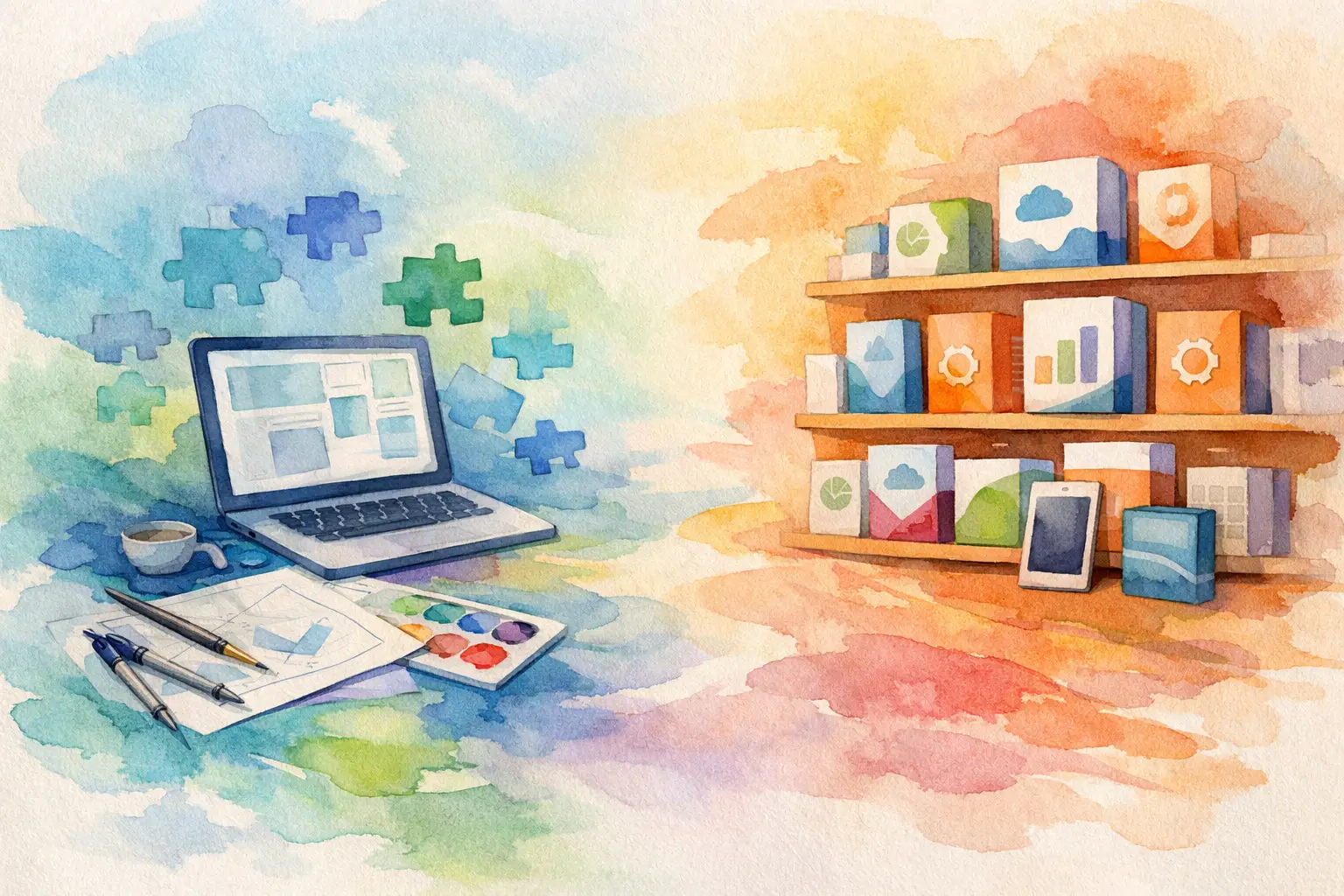
A missed call, a lead stuck in a spreadsheet, and a customer record split across three systems may look like separate problems. Usually, they point to one operational issue: your technology no longer fits the way your business actually works. The custom software vs off the shelf decision is not simply about buying an app or building one. It is a decision about how much control you need over the systems that support sales, service, marketing, and growth.
For small and mid-sized businesses, the right answer is rarely based on features alone. It depends on your process, your team, the cost of workarounds, and how quickly the business needs to move.
Custom Software vs Off the Shelf: The Core Difference
Off-the-shelf software is a ready-made product designed to serve a broad market. Think of common accounting platforms, CRMs, scheduling tools, point-of-sale systems, and project management applications. You pay a subscription or license, configure the available settings, and begin using it quickly.
Custom software is designed around your business requirements. It may be a customer portal, an internal operations dashboard, a field-service workflow, a lead routing tool, or an application that connects several existing systems. Rather than asking your team to adopt a vendor’s standard process, the software is built to support the process that gives your company an advantage.
Neither approach is automatically better. A standard scheduling platform may be the smart choice for a local business that needs reliable appointment booking next week. A custom solution may be the better investment for a growing contractor whose estimators, dispatchers, technicians, and office staff are losing hours every day to duplicate data entry and disconnected tools.
When Off-the-Shelf Software Makes Sense
Off-the-shelf software is often the right starting point when the problem is common and the process does not need to be highly specialized. Most businesses do not need to build their own email platform, video meeting tool, payroll system, or basic bookkeeping application. Established products have already invested in security, updates, user experience, and support for standard use cases.
Speed is the main advantage. A team can often implement a ready-made platform in days or weeks rather than waiting months for a custom build. The initial investment is also easier to predict. Subscription pricing can preserve cash flow, which matters when a company is managing seasonal demand, hiring, or opening a new location.
There is another practical benefit: familiarity. New employees may already know the platform, and third-party integrations may be readily available. For a business owner who needs better visibility into leads or customer communications without delay, a well-selected commercial tool can produce meaningful improvement fast.
The limitation appears when the software becomes something your team has to work around. If employees routinely export data into spreadsheets, enter the same information twice, skip steps because they are inconvenient, or rely on manual reminders to keep customers informed, the subscription fee is not the full cost. The business is also paying in lost time, inconsistent service, and missed opportunities.
Where Custom Software Creates Value
Custom software earns its place when a business process is central to revenue, customer experience, or operational efficiency. It is particularly valuable when your company has outgrown a patchwork of platforms that do not share information reliably.
For example, a multi-location service business may need leads from its website, phone system, online ads, and referral sources to flow into one pipeline. Each lead may need to be assigned based on location, service type, availability, and account history. The right system can alert the right person, record the interaction, trigger follow-up, and give management a clear view of response times and conversion rates.
That workflow can sometimes be assembled from off-the-shelf tools. But when the process includes unique business rules, complex approvals, specialized pricing, compliance requirements, or data from several sources, custom software can reduce friction that standard products cannot remove.
Custom development also gives you ownership over the experience. You can prioritize the features that matter to your staff and customers instead of paying for a large package where only a small percentage of functionality is useful. A custom customer portal, for instance, can present only the information clients need, such as appointment details, project updates, invoices, documents, and support requests.
The goal is not to build technology for its own sake. The goal is to make it easier to capture leads, serve customers, protect margins, and make sound decisions from accurate data.
The Real Cost Comparison
The usual comparison starts with upfront cost. Off-the-shelf software generally costs less to begin with, while custom software requires a larger initial investment for discovery, design, development, testing, implementation, and support.
That comparison is valid, but incomplete. A lower monthly subscription can become expensive if it requires multiple add-ons, extra user licenses, outside consultants, manual work, and separate tools to fill gaps. Businesses should calculate the cost of the full workflow, not just the price on a vendor’s website.
Consider a simple operational question: how many hours does your team spend each week moving information between systems or correcting errors caused by disconnected data? Multiply that time by the fully loaded cost of the employees involved. Then consider the revenue impact of slow lead response, missed calls, delayed quotes, or inconsistent follow-up. Those numbers often reveal whether a custom project has a reasonable payback period.
Custom software also has ongoing costs. It needs hosting, security updates, monitoring, enhancements, backups, and dependable support. A responsible development plan accounts for these requirements from the beginning. Building an application and walking away is not a sustainable technology strategy.
Do Not Confuse Customization With Custom Software
Many commercial platforms allow configuration. You can add fields, create automations, build reports, and connect applications through APIs. That flexibility is useful, and in many cases it is enough.
However, there is a line between configuration and forcing a platform beyond its intended use. If a business needs complicated workarounds, fragile integrations, or staff training built around exceptions, the software may no longer be serving the business well. The fact that a system can be customized does not mean it should carry every part of your operation.
A practical middle path is often the strongest choice. Use proven off-the-shelf tools for standard functions, then build custom integrations, dashboards, portals, or workflow applications where your process is distinct. This approach avoids reinventing reliable commodity software while giving your business control over the areas that affect performance most.
Questions to Ask Before You Build or Buy
Before selecting a platform or approving a development project, leadership should be able to answer a few direct questions. What specific business problem are we solving? What does that problem cost us today? Which employees and customers will use the system? What must connect to it? And how will we measure success after implementation?
Also look beyond the current process. A solution that works for one office, five employees, or 200 monthly leads may not work when the company adds locations, expands service lines, or increases its marketing investment. Technology should support growth without creating a new bottleneck six months later.
It is equally important to define who will own implementation. The best software can fail when data is poorly migrated, employees are not trained, integrations are not tested, or support is difficult to reach when a critical workflow stops working. Businesses need an accountable partner that understands both the technology and the operational outcome.
Choose the Option That Reduces Friction
The best decision is not the most advanced system or the cheapest one. It is the option that makes your business easier to run while supporting the next stage of growth.
Choose off-the-shelf software when your needs are standard, speed matters, and the platform fits your process without costly compromises. Consider custom software when your workflows create competitive value, disconnected systems are draining time and revenue, or customer experience depends on information moving accurately across the business.
At Smargasy, technology planning begins with the business problem, not a predetermined product. A clear view of your workflows, lead sources, communications, and growth goals makes it possible to invest where it will have the greatest impact. Start by identifying one recurring point of friction that costs your team time or customers confidence. That is often the right place to begin.