The relationship began in 2002 with a chocolate maker running its own online store and a problem more basic than most: the store didn't talk to the company's internal ERP system. What customers ordered on the website and what the factory could actually produce and ship were two separate records, reconciled by hand.
Zotter grew from there into one of Europe's more closely watched chocolate makers, now a 230-person operation making 500 chocolates from 400 ingredients, bean to bar, in its own factory in Austria. Multiple relaunches over two decades kept adding pieces that all needed to plug into one site: a wholesale channel, a loyalty program, in-factory hardware, a visitor booking system.
The problem beneath the technical one was never really the ERP integration itself. It was whether one platform could keep absorbing new parts of a growing business for more than twenty years without a full rebuild every time something changed.
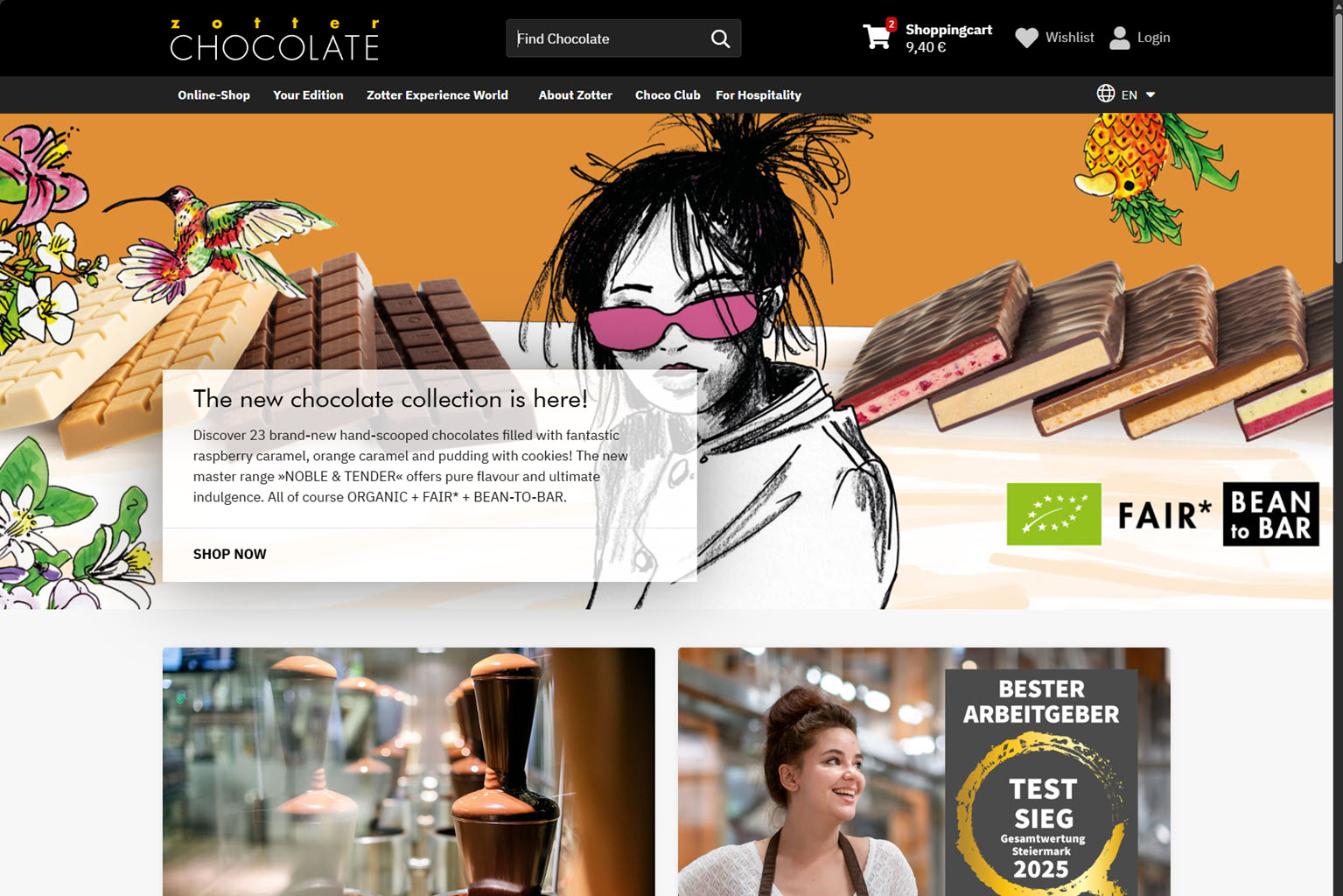
We built the site's core on TYPO3, an enterprise content management system, with a fully custom online store selling roughly 500 ready-made chocolates. We built the store first, before any add-on features, because it generates the bulk of online orders.
On top of it, we added three configurators for customers who want to design something themselves: the Mi-Xing Bar, the Biofekt Configurator for the small handmade confections, and the Motif Designer for custom-printed wrappers. Each one runs the same way on the website and on touch displays inside the factory, tied directly into production, so a design made on-screen becomes a real bar within 20 minutes.
We built a separate reseller portal for bulk ordering, kept on the same site but walled off from the retail experience, and the Zotter Chocolate Club, a points-based loyalty program. Most recently, we built the reservation and ticketing system for factory visitors on Laravel, integrated directly into the same TYPO3 front end rather than running as a separate tool.
The original ERP mismatch is gone. Orders placed online now reflect what the factory can actually produce, which is what the relationship was supposed to solve back in 2002.
Day-to-day, the site has absorbed twenty+ years of new business, wholesale, loyalty, in-factory hardware, and visitor bookings, without needing a new platform each time. The reservation and ticketing system is scheduled for a full renewal in Fall 2026, on the same architecture.
TYPO3 on an enterprise-grade release runs the multi-language site, the store, and the reseller portal. The reservation and ticketing system for factory visitors runs on Laravel, integrated directly into the same TYPO3 front end, and is due for a full renewal in Fall 2026.
In-factory touch displays connect to the same configurator logic used on the website and to production, so an in-store design becomes a real chocolate bar in the same visit.